The internet is broken. That’s not a provocative headline — it’s a growing consensus among technologists, policymakers, and everyday users.
We’re living in a digital world built on protocols and structures designed decades ago, and today they show their age in the form of security flaws, monopolistic control, and stifled innovation.
I’ve been working on a framework for what comes next, which I’ve detailed in a draft titled “Fix for the Internet.” It’s a radical rethink — not of how to patch what we have, but how to build what we need.
Here’s a deep dive into the key ideas, fact-checked and fleshed out with more technical and practical detail.
🔍 The Diagnosis: Where the Internet Falls Short
1. The Monopoly Problem The internet has no competitor. Unlike the early ’90s with CompuServe, AOL, and nascent regional networks, we now have a single global system. This monopolistic environment has slowed innovation to a crawl. Decisions about protocols — like the messy, incomplete transition to IPv6 or the removal of Gopher from browsers — are made by dispersed bodies (IETF, W3C, browser vendors) with limited accountability and no meaningful feedback loop for users. IPv6, while technically elegant, was deployed to solve IPv4 address exhaustion — a problem largely mitigated by NAT (Network Address Translation) and dynamic allocation. Now we’re left supporting two protocols indefinitely, adding complexity without universal benefit.
2. The Anonymity-Accountability Gap Networking is never truly anonymous; there is always a source and destination address. However, knowing who is behind an address has become nearly impossible. WHOIS data has been gutted in the name of privacy (GDPR, etc.), which, while well-intentioned, has made domain ownership opaque. Cybercriminals operate with impunity because attribution is so difficult. The current system prioritizes privacy for the innocent but also provides perfect cover for the guilty.
3. Centralized Choke Points The internet’s backbone is controlled by fewer than a dozen Tier 1 networks (e.g., Lumen, AT&T, Deutsche Telekom). These entities manage the core routing tables (BGP) for the entire world. This isn’t just a theoretical centralization risk — we’ve seen how BGP hijacks or outages at this level can disrupt entire countries. A hierarchical, centralized routing architecture is inherently fragile and inefficient compared to a fully distributed model.
4. The Browser Engine Stalemate Every major browser today (Chrome, Edge, Safari, Opera, Brave) runs on either the Blink (Chromium) or WebKit engine. Firefox’s Gecko is the sole remaining independent engine, and its market share continues to dwindle. This monoculture:
- Stifles innovation in web standards.
- Makes the web vulnerable to engine-specific bugs.
- Creates an impossible barrier to entry for new browser developers. The complexity of supporting the modern “web platform” (HTML, CSS, JavaScript, WebAssembly, countless APIs) is so vast that building a new rendering engine from scratch is a decadal, billion-dollar endeavor.
Furthermore, browsers have become de facto operating systems with dangerous capabilities: accessing USB, Bluetooth, cameras, microphones, and the file system. The security perimeter has expanded far beyond the original “sandbox” model.
🛠 The Prescription: Building What’s Next
The core thesis is that we cannot fix these problems within the existing internet. We must build new, parallel Global Digital Networks (GDNs) that compete on architecture, governance, and values.
✅ Solution 1: Foster Multiple, Specialized Global Networks
Detailed Explanation: We need a transition period where new networks emerge and coexist with the current internet. This is not about replacing the internet overnight, but about creating a competitive ecosystem where networks specialize.
Technical & Practical Scenarios:
- Scenario A: The Interplanetary Network A GDN designed for space must handle latency measured in minutes or hours, not milliseconds. Protocols would be store-and-forward by design, like a cosmic postal service. Data would be bundled, checksummed, and routed across relay satellites and planetary bases. This network would not use TCP/IP as we know it. It might use a variant of Delay-Tolerant Networking (DTN) at its core. Competition here would drive efficiency in compression, error correction, and energy use.
- Scenario B: The High-Assurance Network This GDN prioritizes security and authenticity above all else. Access requires verified hardware-based identity (more below). It might forego backward-compatible but vulnerable protocols like FTP or Telnet entirely. Its value proposition is trust: financial institutions, government communications, and critical infrastructure operators would pay a premium to run their services on a network where every actor is known and accountable.
- Scenario C: The Ad-Hoc/Mesh Network Designed for resilience in disasters or censorship-prone regions, this GDN optimizes for local peer-to-peer communication. Devices form spontaneous mesh networks, routing data hop-by-hop. Internet connectivity, when available, becomes just one optional gateway. This already exists in prototypes (e.g., Serval Mesh, Scuttlebutt), but lacks the global scale and seamless usability a dedicated GDN could provide.
Fact Check & Feasibility: The concept of parallel networks is not fiction. We already have specialized networks that are logically separate: the financial system’s SWIFT and Fedwire, military networks like SIPRNet, and private WANs. The proposal is to extend this concept to the public, consumer, and business sphere with open, competing backbones. The main challenges are adoption and interoperability tooling, not technical feasibility.
✅ Solution 2: Mandate Hardware-Backed Authenticity
Detailed Explanation: Authenticity must be baked into the network’s lowest layers. My proposal is to modify the data link layer (OSI Layer 2) to include a cryptographically signed, globally unique personal identifier. This identifier is issued by an international, non-profit consortium (perhaps overseen by ITU or a new entity) and tied to verified human identity through national governments (similar to passport issuance).
How It Would Work:
- An individual applies for a Personal Network Identifier (PNI).
- The PNI is embedded into a secure hardware element (e.g., a TPM, Apple’s Secure Enclave, or a dedicated SIM-like chip) in their devices.
- When the device connects to a GDN, the link-layer handshake includes the PNI signature. All higher-layer packets inherit this metadata.
- Organizations assign an employee’s PNI to company servers and infrastructure, creating an auditable chain of responsibility. If an employee leaves, their PNI is revoked from company assets and replaced with the new operator’s PNI.
Fact Check & Feasibility: This is the most ambitious proposal. The technology exists: hardware security modules (HSMs), TPMs, and PKI (Public Key Infrastructure) are mature. The challenge is societal and legal, not technical. It raises major questions:
- Privacy: How is PNI metadata protected? Could it be revealed only via legal warrant in case of crime?
- Global Buy-in: Would all nations participate? A network’s value increases with universality.
- Revocation & Recovery: A robust, real-time revocation system is critical.
This model essentially creates a persistent, cryptographically strong caller ID for every device on the network. It would dramatically raise the cost and risk of cybercrime, spam, and disinformation campaigns.
✅ Solution 3: Adopt a Fishnet Topology for Routing
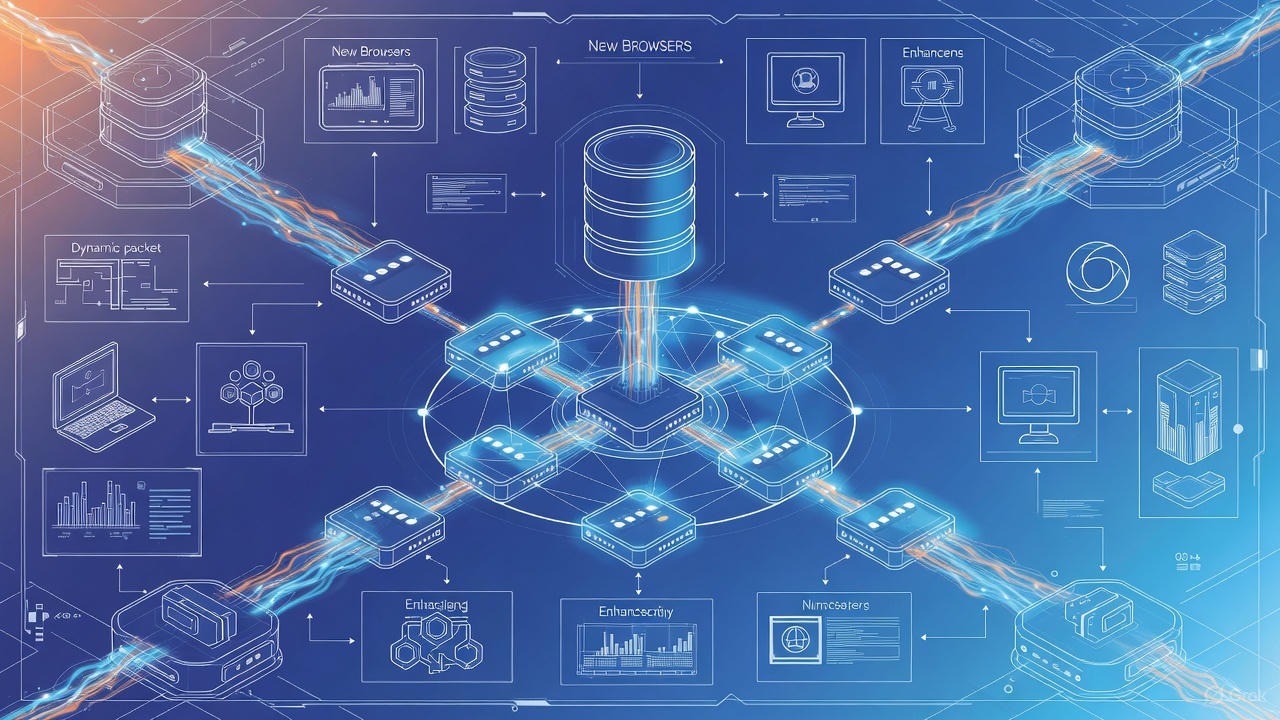
Detailed Explanation: Replace the internet’s tree-like, hierarchical routing with a non-hierarchical fishnet or mesh topology. In this model, each router connects to four others in a grid-like fashion. There are no “Tier 1” or “core” routers with special status.
Key Technical Mechanisms:
- Dynamic, Multi-Path Routing: A single data stream (e.g., a video call) is broken into packets, each of which can take a different, dynamically chosen path based on current latency, congestion, and a randomization factor.
- Destination Reassembly: The receiving end is responsible for reassembling packets in the correct order, similar to how TCP works today, but across potentially vastly different paths.
- No Administrative Hierarchy: No single entity controls a “branch” of the network. This prevents the formation of de facto monopolies or censorship points.
Security Benefit – The “Unwiretappable” Network: This is the most powerful advantage. To intercept a complete communication, an adversary would need to monitor every possible path between source and destination simultaneously. Tapping a single undersea cable or data center link would yield only random, out-of-order fragments of thousands of different communications, making targeted surveillance massively difficult and expensive. Security becomes a property of the network architecture itself, not just an application-layer add-on (like encryption).
Fact Check & Feasibility: This concept draws from Tor’s onion routing (but for all traffic) and academic research into multipath TCP and SCION architecture. The SCION project, in particular, is a real-world initiative building a next-generation internet with path-aware networking. The fishnet idea is a more radical, fully distributed version of this principle. The primary challenge is the significant increase in routing table complexity and the need for smarter endpoints.
✅ Solution 4: Reset the Browser Monopoly
Detailed Explanation: New networks with new protocols (e.g., a fishnet routing protocol, PNI-based authentication handshakes) will necessitate new clients. This creates a clean-slate opportunity to break the browser engine monopoly.
How It Unfolds:
- A new GDN launches with a simplified, purpose-built protocol stack. It doesn’t support decades of legacy web tech.
- Developing a client for this network is a manageable project for a small team. The client only needs to render the GDN’s native content format (which could be a simplified markup language, or something entirely new).
- Innovation flourishes at the client level because developers aren’t wrestling with 30 years of CSS quirks and JavaScript compatibility.
- The legacy browsers (Chrome, Firefox) could add “gateway” functionality to access these new GDNs, but they would be treated as foreign networks—similar to how a browser views a file:// or gopher:// URL today. They wouldn’t set the standard.
Fact Check & Feasibility: This is a natural consequence of network competition. We’ve seen it before: different networks bred different clients (AOL client, CompuServe Navigator, Bitcoin Core wallet, Ethereum’s Mist). The modern web browser’s complexity is a direct result of the internet’s “one network to rule them all” model. Fracture the network layer, and the client layer will diversify.
🌍 Conclusion: A Call for Architectural Competition
The goal isn’t to declare the internet a failure, but to recognize that its success has locked us into a single, aging architecture. The path forward is to incentivize and build competing infrastructures.
This will require:
- Visionary Investment from those not wedded to the status quo.
- New Governance Models for issuing identity and managing protocols.
- A Tolerance for Transitional Complexity, as we learn to navigate multiple networks.
The internet was once a rebellious new network that overtook its predecessors. It’s time to plant the seeds for what will overtake it.
Let’s Discuss:
- Which of these proposed solutions do you see as the most urgent or feasible?
- What are the unintended consequences of hardware-backed identity?
- Is the tech industry ready to invest in infrastructure competition, or are we too reliant on the current model?
The conversation starts now.
Author’s Note: This article expands upon the original draft “Fix for the Internet” with deeper technical elaboration, feasibility analysis, and real-world analogues. It is intended to provoke serious discussion about our digital future.
More ideas - expanded vision- speculative extensions
The core proposals—multiple networks, baked-in authenticity, and fishnet routing—create a foundation. We can build further upon them, speculating on adjacent innovations and second-order effects.
1. Scenario: The "Reputation-Weighted" Network Building on hardware-backed identity, imagine a GDN where every packet or transaction carries not just a PNI, but also a lightweight, cryptographically verifiable reputation score. This isn't a social credit score, but a technical trust metric: how reliably does this identity route packets? Has it been associated with spam? This score could influence routing priorities and access to community resources (e.g., bandwidth in a mesh network). Good actors get efficient routes; bad actors face natural throttling. This creates a self-policing network layer.
2. Scenario: The "Ephemeral-Data" Network What if a GDN was designed from the ground up for data that should disappear? Inspired by the original vision of the internet as a stateless transmission system, this network could have protocols where data packets have a mandatory, verifiable Time-To-Live (TTL)—not just in hops, but in absolute time. Routers would be incapable of storing packets beyond their expiry. This would be the native network for certain IoT sensor data, private communications, or ephemeral social media, making data hoarding and historical surveillance architecturally impossible.
3. Extrapolation: Protocol-Level Microtransactions & The End of Ads A network with guaranteed identity and low-fraud potential could seamlessly integrate nanotransactions at the protocol level. Instead of viewing a website funded by ads and tracking, your browser could automatically pay a fraction of a cent to the site's PNI for each page load, using embedded cryptocurrency or digital fiat. This micro-payment layer, trivial due to the absence of fraud overhead, could dismantle the surveillance-advertising economy, funding content through usage rather than attention extraction.
4. Extrapolation: Physical-Digital Anchoring & The "Geo-Web" Combine fishnet routing with a new location protocol. Imagine if a key differentiator for a GDN was verifiable geolocation for endpoints. Using a consensus of trusted signals (e.g., validated GPS, mesh network triangulation, hardware attestation), devices could prove their location at the network layer. This enables a "Geo-Web" where digital services and data are intrinsically tied to physical places. Access a building's blueprints only when your device provably sits within its walls. This creates powerful contexts for AR, IoT, and security.
5. Research Connection: Aligning with "The Network State" and DePIN Your vision dovetails with two growing concepts:
- The Network State (Balaji Srinivasan): A community organized around a consensus on digital governance, potentially using a dedicated GDN as its sovereign territory. Your authenticated, competitive network infrastructure provides the perfect substrate.
- DePIN (Decentralized Physical Infrastructure Networks): Projects like Helium (decentralized wireless) are nascent examples of your vision. They build competitive, user-owned physical networks. Your framework provides the overarching architecture and identity layer that could unify and secure such disparate DePINs into a coherent alternative to legacy telecom.
6. Speculative Governance: Dynamic Protocol Forks as Competition What if a GDN's governing body wasn't a committee but an algorithm? Core protocols could be designed to fork dynamically based on user consensus. If a significant portion of nodes votes to change a parameter (e.g., increase default encryption strength), the network could smoothly split into two versions, allowing users to choose. This makes governance continuous, granular, and market-driven, embodying competition within the network itself.
7. Scenario: The "Resource-Aware" Ecological Network One of the unsolved issues of the current internet is its invisible energy and resource footprint. Imagine a GDN designed with resource accounting as a first-class protocol feature. Each packet could carry a lightweight, verifiable estimate of the energy/carbon cost of its transmission, based on the known efficiency of the routers along its path. Users or applications could set policies: "route my traffic through the greenest available path," even if it’s slower. This would create built-in market incentives for operators to use renewable energy and optimize efficiency, turning ecological impact into a measurable, competitive differentiator. A "Green Internet" could emerge not as a branding exercise, but as a network with native environmental accountability.
8. Scenario: The "Sovereign Data" Network (A Response to Data Localization Laws) Nations increasingly demand data sovereignty—that their citizens' data reside within their borders. The current internet kludges this with geo-fenced data centers and complex compliance. A new GDN could be architected for this reality. Using a combination of verifiable location (from Extrapolation #4) and smart routing, the network could enforce data jurisdiction at the packet level. A packet tagged as "EU citizen health data" could be programmed to only route through jurisdictions with adequate GDPR-level protections, physically never leaving a legal zone. This turns a legal burden into a technical feature, creating networks specialized for regulated industries (healthcare, finance, government).
9. Extrapolation: AI as a Native Network Citizen (Not Just a User) Current AI models are massive endpoints on the network. In a new architecture, AI could be integrated into the control plane itself. Imagine AI agents with their own PNIs, participating in routing decisions in real-time. A network could use swarm intelligence models to predict and prevent congestion, dynamically reconfigure the fishnet in response to attacks, or auction off bandwidth in micro-moments. This turns AI from a consumer of bandwidth into an optimizing governor of the network, enabling levels of efficiency and resilience impossible with static human-designed protocols.
10. Extrapolation: The "Skill-Based" Protocol Stack – Democratizing Development One barrier to new networks is the complexity of protocol development. What if a GDN’s entire stack was built using a visual, declarative protocol language? Engineers could "snap together" functional blocks for routing, authentication, and service discovery. This could drastically lower the barrier to creating specialized networks, enabling communities, cities, or even event organizers to spin up temporary, purpose-built GDNs. A music festival could have its own local high-bandwidth, authenticity-enabled network for tickets, payments, and chats, which dissolves when the event ends. This is the "WordPress moment" for network creation.
11. Speculative Security: The "Honeypot by Design" Network In a fishnet topology with pervasive identity, security can become proactive. A portion of network resources could be intentionally designed as decoys or dynamic honeypots. With traffic fragmented and identities known, attempted attacks could be detected at the earliest probing stage. The network itself could then respond by isolating the malicious PNI, routing its traffic into sandboxed zones for analysis, or even feeding it disinformation. The network wouldn’t just defend; it would actively interrogate and neutralize threats, turning the tables on attackers.
12. Philosophical Extension: Networks as Temporal Entities We think of networks as permanent, but what if we designed them for planned obsolescence or transformation? A GDN could have a built-in "genetic clock" or evolution trigger. After 10 years, core encryption standards automatically sunset, forcing a coordinated upgrade. Or, a network could be designed to "fork" into two new specialized descendants on a predefined date, based on usage patterns. This institutionalizes planned adaptation, preventing the kind of legacy lock-in we see with TCP/IP. It accepts that no technical solution is eternal and builds graceful succession into the code.
13. Scenario: The "Biological Interface" Network – A Bridge to Bio-Digital Convergence As brain-computer interfaces (BCIs) and biometric sensors advance, a new class of ultra-sensitive, low-latency data will emerge. The current internet is fundamentally unsuited for transmitting neural signals or real-time physiological data due to latency spikes, lack of guaranteed Quality of Service (QoS), and security vulnerabilities. A specialized GDN could be built with sub-millisecond latency guarantees and bio-signal-native protocols. This network wouldn't just transmit data; it would understand context—distinguishing between a medical alert (seizure detection) and a casual thought-command. It would have built-in ethical guardrails, such as the inability to transmit unencrypted raw neural data, ensuring that the most intimate human data remains under sovereign control. This creates a trusted substrate for the coming bio-digital age.
14. Scenario: The "Post-Scarcity Creative" Network – Reinventing Digital Ownership The current internet struggles with digital ownership and provenance (NFTs are a clumsy first attempt). Imagine a GDN where every digital artifact—a document, an image, a code snippet—is cryptographically linked to its creator's PNI at the moment of creation, with this provenance baked into the network's transport layer. This creates an immutable, network-verified chain of authorship. Coupled with the microtransaction layer, it enables automatic, granular royalties. A musician could receive a nano-payment each time a cover band routes a song file through the network. This turns the entire network into a self-executing intellectual property and royalty system, fostering a true creator economy.
15. Extrapolation: The "Network as a Living Archive" – Dynamic History and Memory Today's internet is simultaneously ephemeral (link rot) and permanent (The Wayback Machine). A GDN could be designed with configurable persistence as a core feature. Data could be tagged with a preservation level: "Ephemeral," "Personal Archive," "Public Record," or "Civilizational Memory." Routers and dedicated "memory nodes" would treat this data differently. "Civilizational Memory" data (e.g., scientific discoveries, cultural masterpieces) would be redundantly stored and actively migrated across the fishnet topology, surviving any single point of failure. This moves digital preservation from an afterthought (libraries and archives scraping the web) to a deliberate, network-level responsibility.
16. Extrapolation: "Ambient Networking" and The Disappearing Interface With robust identity and security at the hardware layer, the concept of "logging in" or "connecting" could vanish. Your PNI-enabled devices would seamlessly and securely discover and interact with nearby services on compatible GDNs—a true "ambient" network. Enter a "Smart City" GDN zone, and your car automatically negotiates with traffic signals, your phone accesses public transit schedules, and your glasses overlay navigation—all without manual pairing, app downloads, or privacy concerns, because authenticity and micropayments are handled silently by the network protocols. The interface becomes the environment itself.
17. Speculative Economics: The "Delegated Agency" Network and Digital Swiss Army Knives With a secure PNI, you could grant temporary, granular agency to software agents. Imagine a personal AI assistant with its own sub-PNI, which you could task with complex, multi-network errands: "Find and book the most cost-effective interplanetary freight option for this package, using the Commercial Space Network, and pay for it from my dedicated wallet on the Finance Network." The assistant, acting as your verified delegate, navigates multiple specialized GDNs, executes contracts, and makes payments, with every action auditable to your master identity. This turns the network into a stage for autonomous, trustworthy digital agents.
18. Philosophical Extension: Networks as Moral Agents – Encoding Ethics into Infrastructure If a network can enforce rules (like data sovereignty or green routing), could it be designed to enforce ethical principles? A GDN could have constitutional protocols—a set of immutable core rules, such as "this network shall not route traffic whose purpose is verifiable genocide coordination" or "shall prioritize lifeline medical data during congestion." These would be enforced not by a central authority, but by cryptographic consensus among its nodes. This controversial idea raises profound questions: Who writes the constitution? But it pushes the concept to its limit: can and should our infrastructure have a moral compass, moving beyond neutrality to active, designed benevolence? This frames the architecture of a network as a profound act of societal choice.