
based on my quick notes: Fix for the internet
The Internet Is Ossified – And That Is Dangerous
The internet has become a single, global utility with no real alternative at comparable scale. There are many ISPs and platforms, but they all sit on top of one architecture whose core assumptions have barely changed in decades.
Researchers have long warned that incremental patching cannot fully fix the internet’s structural flaws. Stanford’s Clean Slate Program, for example, explicitly asked how a global communications infrastructure would look if designed from scratch with today’s knowledge, rather than constrained by backwards compatibility. That question is no longer academic; connectivity now underpins finance, healthcare, supply chains, and democratic processes.
Before the web and TCP/IP took over, services like CompuServe and AOL offered alternative models of online connectivity. When the open internet won, those walled gardens disappeared – but nothing replaced them as genuinely independent, global alternatives. The result is an ossified core: one routing system, one addressing scheme family, one broad security model, and a narrow space for experimentation.
When One Set of Decisions Shapes Everything
The IPv4-to-IPv6 transition shows how difficult it is to evolve a single, global network. IPv4’s roughly 4.3 billion addresses are insufficient for billions of phones, sensors, servers, and vehicles; regional registries have formally exhausted IPv4 and rely on reclamation and address markets. IPv6 offers a vastly larger space and new features, but deploying it widely has taken decades and still requires most systems to run dual stack.
This dual world introduces complexity and inertia:
- Operators must maintain two parallel address families and transition mechanisms.
- Application developers must test and debug behaviour in mixed IPv4/IPv6 environments.
At the same time, older protocols that represent different ways of thinking about information – such as Gopher’s hierarchical, low-overhead model – quietly vanish from mainstream support. They are not necessarily worse; they are simply inconvenient to maintain within the dominant web stack and economic model.
Scenario – scientific publishing: Imagine a long‑lived scientific archive designed around a simple, tree-like document protocol with extremely low overhead and strict versioning, something closer to an evolved Gopher than HTTP. Such a system could be optimized for long-term stability and clarity, but it is difficult to deploy on today’s internet without riding on top of the web, inheriting its complexity and commercial layers. The architecture subtly pushes everything toward the same solution, even when another would fit better.
Clean‑slate research repeatedly concludes that many of these issues are not bugs but consequences of design choices that made sense decades ago. The core assumptions – host‑based addressing, best‑effort forwarding, weak authenticity, and hierarchical routing – shape what is easy and what is almost impossible.
Authenticity: The Missing Layer
At the physical and network level, there is never true anonymity; packets always have sources and destinations. At the human level, however, the internet is notoriously opaque: who is actually behind a domain, a server, or a botnet is often extremely hard to determine.
Privacy laws and business practices have further obscured ownership:
- WHOIS records that once showed registrant details are now often redacted or replaced by privacy proxies.
- Hosting services and bulletproof providers allow rapid setup and tear-down of infrastructure with minimal verified identity.
Meanwhile, attackers take advantage of weak authenticity at scale:
- Phishing campaigns send seemingly legitimate invoices or login pages from lookalike domains with hidden ownership.
- Ransomware operators route their traffic through layers of compromised machines and anonymizing relays, making attribution to specific individuals extremely difficult.
Scenario – supply chain attack: A logistics company integrates directly with a supplier’s systems to exchange orders and shipping data over APIs. An attacker compromises the supplier’s credentials, uses a lookalike domain with redacted ownership, and injects fraudulent shipping instructions that reroute high‑value cargo. Even after the breach is discovered, untangling which human is responsible – the attacker, a negligent admin, a reseller, or a compromised workstation – is slow and uncertain.
Identity in today’s internet is an overlay: passwords, certificates, SMS codes, KYC procedures, and fraud analytics sit on top of a network that itself does not know or care who is behind each packet. This patchwork keeps commerce functioning, but it does not make cybercrime prohibitively risky at human scale.
Backbone Concentration and Hierarchical Fragility
Beneath all of this lies a relatively small set of Tier 1 backbone providers that exchange traffic settlement‑free and form the core of global routing. Depending on methodology, analyses name on the order of eight to twenty major Tier 1s – not hundreds.
Routing between networks is handled by BGP, a protocol designed for policy flexibility, not cryptographic security or optimal performance. Misconfigurations, route leaks, and hijacks at a handful of key operators can cause global reachability issues or divert traffic through unexpected paths.
Scenario – misrouted healthcare traffic: A regional ISP accidentally announces overly broad routes learned from a Tier 1, and these propagate through the core. Requests from hospitals to cloud‑hosted medical systems suddenly take long detours through distant regions, causing latency spikes and intermittent failures precisely when clinicians need reliable data.
This concentration also creates attractive surveillance and attack points: tapping a few submarine cables or compromising a limited number of backbone routers can expose large volumes of traffic. Encryption mitigates some risks, but metadata and side channels remain valuable for monitoring and profiling.
Browser Monoculture and the Expanding Attack Surface
On the user side, three major browser engines dominate: Blink, WebKit, and Gecko, with Blink-based browsers (Chrome and numerous Chromium derivatives) holding the majority share.
Browsers have evolved from document viewers into full-fledged execution environments:
- They expose APIs for USB, Bluetooth, microphones, cameras, GPU compute, and local storage.
- They support an enormous set of features accumulated over decades, including many legacy behaviours kept for compatibility.
Scenario – industrial control risk: An energy utility uses web-based dashboards in control rooms, accessed via standard browsers, to monitor and adjust power flows. A vulnerability in a widely used engine allows a crafted web page to escape the browser sandbox and interact with USB-connected devices or local configuration files. Because the same engine underpins most corporate desktops, a single bug becomes a systemic risk across many critical infrastructure operators.
Monoculture amplifies every error. Diverse engines and more specialized clients would reduce this, but maintaining a fully compatible browser that supports “all websites” is now so complex that only a handful of organizations can afford it. The architecture has effectively locked in a tiny set of gatekeepers at the user edge.
A Different Approach: Multiple Global Networks
An alternative trajectory is to allow multiple, independent global networks to emerge alongside the existing internet, each with distinct design goals and governance.
These networks would not be simple clones. They would compete on:
- Governance and protocol lifecycle: how new capabilities are added and obsolete ones retired.
- Security and identity models: how authenticity and privacy are handled.
- Topology and routing strategies: how traffic flows and how resilience is achieved.
From the user’s perspective, this can be largely transparent. Devices already juggle multiple physical links (Wi‑Fi, 4G/5G, VPNs) and route traffic according to policy without user involvement. Similarly, an operating system could choose between the legacy internet and one or more new networks based on application requirements.
Scenario – dual‑network enterprise: A global bank adopts a high‑assurance network for all transaction and settlement systems, while continuing to use the traditional internet for marketing, recruitment, and general information. Employees access both from the same workstation, but the OS enforces that certain applications and ports can only talk over the high‑assurance network, which has different identity and routing guarantees.
New networks can also specialize:
- A delay‑tolerant interplanetary network, using protocols like Delay/Disruption Tolerant Networking (DTN), already being developed by NASA for deep space missions, where latency and disruptions are normal.
- A security‑first network that treats authenticity and accountability as foundational, making high‑volume cybercrime significantly harder and less profitable.
DTN, for example, uses store‑and‑forward techniques to ensure data delivery over intermittent links in space or other challenged environments. It is a concrete demonstration that fundamentally different network designs are both possible and necessary for some use cases.
Building Authenticity Into the Architecture
A security‑first network can treat person‑level authenticity as a core design element rather than an afterthought.
The model looks like this:
- Each human can obtain multiple cryptographic identifiers from a global registry, distributed via national or regional authorities.
- Devices must load a valid identifier to participate in the network, enforced by secure hardware similar to today’s trusted execution environments and secure elements.
- Identifiers are referenced at the link layer, so all higher protocols are implicitly bound to a specific human, even if higher layers use pseudonyms or privacy-preserving techniques.
Scenario – high‑value payment network: A specialized payment network for large interbank transfers requires that every system involved – endpoints and intermediaries – operate under identifiers traceable to specific individuals in each institution’s operations and security teams. If a fraudulent or erroneous transfer occurs, investigators can see which human‑bound identifiers were used at each hop, rapidly pinpointing where controls failed or were abused.
Such a system shifts incentives:
- Malware authors cannot easily hide behind botnets of fully anonymous machines; every infected device still has a person‑bound identifier that can be revoked.
- Organizations must ensure that critical infrastructure is explicitly mapped to responsible humans; “orphaned” systems without clear accountability cannot join the network.
This does not have to obliterate privacy. Multiple identifiers per person allow compartmentalization (work, personal, pseudonymous), and higher-layer protocols can use cryptography to conceal which real-world person is behind a given interaction except under well-defined conditions. Social and identity research already treats people as embedded in multiple overlapping “identity networks,” where different roles and group memberships interact; a technical identity layer can mirror that complexity rather than collapse it.
Fishnet Topology: A More Resilient and Private Fabric
A fishnet-like topology, where routers are peers in a flat mesh rather than nodes in a strict hierarchy, complements this identity model.
In such a network:
- Routers connect to a fixed number of neighbours, and no small set of organizations can easily monopolize large choke points.
- Routing decisions use distance, congestion, and randomization to spread traffic across many equivalent paths.
Scenario – censorship and resilience: A country attempts to censor a particular service by pressuring a few large backbone providers to block its routes. In a fishnet topology with many equal peers and randomized multi‑path routing, there is no simple set of choke points to coerce; blocking would require large-scale, highly visible intervention at many nodes, raising the political and economic cost of censorship.
Scenario – interception limits: An intelligence agency taps a single undersea cable in hopes of gathering strategic traffic. In a traditional, hierarchical topology, that cable might carry a large fraction of flows between two continents. In a fishnet‑like system using multi‑path routing, each cable carries only fragments from many flows, with packets of any single conversation taking different routes and arriving out of order, making reconstruction much harder without broad and coordinated access.
Delay/disruption-tolerant networking already applies similar ideas in harsh environments, where intermittent connectivity and long delays require store‑and‑forward across multiple hops. Extending multi‑path, mesh‑like principles to planetary‑scale terrestrial networks is ambitious but technically plausible and aligns with existing research directions.
New Networks, New Clients
Once networks begin to diverge meaningfully, client software can diverge too. Browsers and other clients no longer need to support “everything ever deployed on the web”; they can target a curated set of protocols aligned with their network’s goals.
On an authenticity‑first network, a browser‑like client could:
- Display which real individuals (via their identifiers) are accountable for a site or service, making ownership and responsibility visible.
- Operate with constrained capabilities, deliberately excluding high‑risk APIs such as arbitrary USB or Bluetooth access.
Scenario – healthcare client: A specialized healthcare client runs on a secure tablet used in hospitals to access patient records over the authenticity‑first network. The client is incapable of installing arbitrary plugins, accessing USB devices, or visiting general websites; it only speaks a small set of medically-focused protocols and surfaces clear accountability information for every service it contacts.
Because each network defines a tighter, more modern protocol set, alternative engines become more feasible again. Instead of a single dominant browser family trying to support every legacy feature, multiple lean clients can coexist, each optimized for its network’s guarantees and threat model.
From One Internet to an Ecosystem of Networks
The current internet has served humanity extraordinarily well, but its foundational choices impose constraints that are increasingly visible and costly: weak built‑in authenticity, concentrated routing power, and a fragile browser monoculture.
Research on clean‑slate architectures, delay‑tolerant networking, and identity in networked societies shows that radically different designs are possible. Moving from a single global network to an ecosystem of competing networks – some optimized for security, some for extreme latency, some for specialized industries – would bring competition and innovation back into the foundations of connectivity, not just the apps on top.
Designing and deploying such networks is not trivial. It requires new governance models, careful privacy engineering, and international cooperation. But the alternative is to continue patching an architecture that was never built for the central role it now plays in society.
Additional concrete, real‑world style scenarios
These map directly onto the ideas in your article and push them a bit further.
Authenticity‑First Network Scenarios
1. Public Procurement Without Shadow Bidders
A national government moves all large public tenders (infrastructure, defense, healthcare) to an authenticity‑first network where every participating organization must bind bids to specific person‑identifiers for the responsible executives and compliance officers.
- Shell companies cannot hide behind opaque registrars or mailbox addresses because their network presence requires identifiers bound to real individuals, verifiable through the global registry and national authorities.
- When an investigation into corruption or bid‑rigging occurs, prosecutors can see exactly which human‑bound identifiers created, approved, and submitted each bid and amendment.
Effect: “Shadow bidders” and disposable entities become far less attractive, because they cannot exist as free‑floating, anonymous infrastructure on the network.
2. Social Media With Traceable Abuse (When Needed)
A new social platform launches on the authenticity‑first network with strong pseudonymity at the application layer but hard constraints at the network layer.
- Users can post under handles and pseudonyms; other users and the platform do not see their real‑world identity.
- Serious abuse (death threats, coordinated harassment, disinformation campaigns) can trigger a legally supervised process where selected identifiers behind abusive traffic are unmasked and traced to physical persons.
Effect: Everyday speech remains pseudonymous, but large‑scale, high‑impact abuse becomes traceable to specific people, changing the risk calculus for organized troll farms and harassment networks.
3. Ransomware Negotiation That Cannot Hide
A hospital hit by ransomware is forced to engage with attackers to obtain decryption keys. On the authenticity‑first network:
- The attackers’ infrastructure and negotiation channel must operate under person‑bound identifiers to even connect.
- Law enforcement can passively log all communication metadata and then move to revoke identifiers and seize infrastructure once sufficient evidence is gathered.
Effect: Running ransomware as a sustained business model becomes extremely risky; any repeated activity leaves a trail through the identity infrastructure, pushing attackers back into much smaller, less scalable operations.
Fishnet Topology & Routing Scenarios
4. Regional Disaster, Global Continuity
A major earthquake hits a coastal region, damaging several submarine cables and data centers.
- In today’s hierarchical routing world, traffic often depends on a few key cables and nodes; damage causes long outages and congested reroutes through surviving paths.
- In a fishnet topology, core routers treat the failure as just another dynamic constraint; traffic shifts across many other equal‑cost paths with built‑in randomness to avoid overloading any one route.
Effect: Services used globally (payments, messaging, logistics) continue operating, perhaps with slightly higher latency, but without the catastrophic cascading failures seen when a few choke points fail.
5. Authoritarian Throttle vs. Mesh‑Like Core
An authoritarian government wants to throttle an opposition news outlet hosted abroad.
- On the current internet, pressuring or co‑opting a few domestic transit providers and international gateways can effectively cut connectivity to specific destinations.
- In a fishnet‑like core, where many mid‑tier networks peer laterally and routing is randomized, it is much harder to surgically filter a single target without broadly breaking or degrading service for many unrelated flows.
Effect: The political cost of censorship rises: blunt, obvious shutdowns become the only reliable option, making control more visible domestically and internationally.
6. Corporate Espionage Meets Fragmented Flows
A competitor wants to spy on a global manufacturer’s traffic to understand its new product rollout plans.
- Today, infiltrating a single key cable, IX, or large transit provider can yield a surprisingly coherent view of particular flows.
- In a fishnet topology, flows are automatically split and spread; intercepted fragments from one tap are essentially random slices of many conversations, and reconstructing a specific flow requires access to a large fraction of the mesh.
Effect: Industrial espionage by bulk traffic capture becomes significantly less practical; attackers must revert to endpoint compromise or human insiders, which are riskier and less scalable.
Multi‑Network World Scenarios
7. “Critical Ops Net” vs. “Open Net” Inside One Company
A global logistics company decides to separate operations:
- A Critical Ops Net (new security‑first network) for routing trucks, ships, and aircraft; warehouse robotics; customs filings; and real‑time inventory.
- The Open Net (today’s internet) for marketing, recruitment, general web browsing, and customer support chat.
Policies on employee devices enforce:
- Logistics applications can only connect over Critical Ops Net, where all devices, services, and admins must use person‑bound identifiers and strict routing.
- Browsers, email, and generic SaaS stay on the Open Net, with traditional defenses but without risking direct exposure of control systems.
Effect: Even if employees click phishing links or get malware via the Open Net, the lateral movement path to the company’s operational heart is sharply limited by network separation and identity requirements.
8. Sector‑Specific Networks: “MedNet” and “GridNet”
Over time, industries converge on sector‑specific networks:
- MedNet for healthcare: identity‑bound, with regulated clients, industry‑specific protocols, and built‑in logging and consent tracking.
- GridNet for energy: tuned for real‑time telemetry, authenticated control commands, and multi‑path routing to maximize resilience.
Hospitals, clinics, insurers, and regulators agree that all patient record exchange and high‑risk medical device updates must run on MedNet. Power generators, grid operators, and regulators mandate that all SCADA and dispatch communications use GridNet.
Effect: Attacks targeting healthcare or power infrastructure cannot just ride general‑purpose internet pathways and commodity browsers; they must break into tightly governed, identity‑rich environments, raising the bar for attackers and reducing collateral damage from generic malware.
Interplanetary & Delay‑Tolerant Networking Scenarios
9. Mars Colony Commerce
A future Mars settlement uses a delay‑tolerant, interplanetary network to connect with Earth.
- Latency between Earth and Mars can be from 4 to more than 20 minutes one way, making traditional request/response web protocols inefficient.
- Commerce, governance, and science use store‑and‑forward bundles; contracts, software updates, and large data sets are queued and transported asynchronously across scheduled communication windows.
A company offering “real‑time cloud services” for Mars quickly fails because it tries to shoehorn terrestrial web assumptions into a fundamentally different delay environment. A new “SpaceNet” protocol stack emerges, better aligned with human and economic realities at interplanetary scale.
Effect: The existence of SpaceNet normalizes the idea that different global networks can exist with their own rules, independent from the legacy internet.
10. Disaster Recovery via DTN Overlay
On Earth, regions prone to hurricanes or wildfires adopt delay‑tolerant overlays on top of a fishnet topology.
- When infrastructure is damaged and links are intermittent, data such as evacuation orders, medical supply manifests, and situation reports can still propagate via store‑and‑forward between moving vehicles, drones, and temporary links.
- The authenticity‑first design ensures that every emergency message is bound to a specific responder’s identifier, reducing the risk of spoofed instructions in chaotic environments.
Effect: Critical information still flows in the worst conditions, but with strong assurances that messages are genuine and traceable to real responders.
New Clients & Browser Alternatives Scenarios
11. “Thin Clients” for Finance
A consortium of banks builds a dedicated client for a high‑assurance financial network.
- The client cannot browse the open web at all; it only speaks a narrowly defined set of protocols (e.g., secure settlement instructions, liquidity reporting).
- The software stack is small enough to be fully audited regularly by regulators and independent security labs.
Effect: Zero‑day browser exploits that threaten billions of consumer devices have no direct path into this financial core, because the client is neither a general‑purpose browser nor running on the broad protocol soup of the public internet.
12. Regulated “Children’s Network” with Hardened Clients
Governments and NGOs cooperate to build a dedicated network for under‑18 users, with:
- Strict identity issuance to parents/guardians and minors (age‑bounded identifiers), managed via national authorities.
- Hardened clients that can only connect to approved educational, social, and entertainment services with clear accountability for operators.
Advertising, profiling, and data collection are heavily constrained by network‑level rules; attempts to deploy unauthorized services are blocked at the routing and identity layers. Parents receive visibility into which services their children’s identifiers interact with, without seeing content details.
Effect: Instead of relying solely on app‑store policies and content filters on the open internet, children’s digital experiences move to a network where safety and accountability are embedded in the architecture.
These scenarios are meant to make the ideas feel operational: identity‑first networking, fishnet topologies, and multiple specialized networks are not just abstract protocol tweaks but levers that can reshape how sectors like finance, healthcare, energy, governance, and even interplanetary exploration operate day to day.
Practical experiments you could run today
To test pieces of your proposed models in the real world.
1. Authenticity-Bound Networking (Person Identifiers)
1.1 Lab-Scale Identity-Bound Network
Goal: Test whether binding all traffic to human-linked identifiers improves accountability without destroying usability.
Steps:
- Set up an isolated network segment (e.g., a lab VLAN) with 20–50 users and devices.
- Issue each participant a cryptographic identifier (e.g., keypair + certificate) tied to their verified identity in your IAM/HR system.
- Require devices to present a valid identifier at link-up time (e.g., via 802.1X, mTLS at the edge, or a custom agent), and tag all flows with that identity in logs.
- Route all traffic through a monitoring point that: Logs identity, device, and application. Flags policy violations (e.g., port scans, exfiltration tests, malware simulations).
What to measure:
- Time-to-attribution for policy breaches or simulated attacks.
- User friction: onboarding time, frequency of identity issues, perceived privacy concerns.
- Operational overhead for issuing, revoking, and rotating identifiers.
Validation: If security incidents in the lab can be attributed to specific individuals within minutes, and users still find the system workable, it supports the claim that person-bound identifiers improve accountability substantially.
1.2 Identifier Delegation for Servers
Goal: Test organizational mapping of responsibility: servers carry identifiers of accountable people, not abstract “org” IDs.
Steps:
- Select a set of critical internal services (e.g., internal APIs, CI/CD servers, databases).
- For each service, assign two or three responsible engineers, each with their own identifiers.
- Require that services authenticate using one of the responsible engineers’ identifiers, not a generic service account.
- When staff change roles, enforce a process where: Old identifiers are removed from the service. New engineers’ identifiers are added.
What to measure:
- How often services run with “orphaned” identifiers after people leave.
- How quickly you can reconstruct a chain of human responsibility during incidents.
Validation: If incident post-mortems become clearer (“this server ran under A, then B, then C”) and drift is reduced, it strengthens your argument that tying servers to people, not organizations, improves authenticity and accountability.
2. Fishnet-Style Routing and Multi-Path Experiments
2.1 Emulated Fishnet Topology
Goal: Test resilience and traffic fragmentation benefits of a fishnet-style mesh compared to hierarchical routing.
Steps:
- Use containers/VMs or a network emulator (e.g., Mininet, GNS3, or Kubernetes + service mesh) to build two topologies: Traditional: core/aggregation/edge hierarchy. Fishnet: flat grid where each router has 3–4 equal peers, no explicit hierarchy.
- Implement routing that uses: Shortest path. Load information. A randomization factor to choose among near-equal paths.
- Run identical test traffic through both topologies: Web-like flows (many small requests). Bulk transfers. Latency-sensitive flows (voice/video).
- Introduce failures and targeted taps: Random link/router failures. “Wiretap” nodes that capture packets on selected links.
What to measure:
- End-to-end availability and latency under failures in both topologies.
- How much of a single flow an attacker can reconstruct from one or a few tapped links.
Validation: If the fishnet model shows smoother degradation under failures and a much higher number of taps needed to reconstruct flows, it provides empirical support for your claims on resilience and interception difficulty.
2.2 Partial Fishnet Overlay on an Existing Network
Goal: Test whether adding fishnet-like routing as an overlay improves resilience over an existing enterprise or campus network.
Steps:
- Deploy an overlay network (e.g., VPN mesh, SD-WAN, or service mesh) across multiple sites.
- Configure it to: Maintain multiple paths between sites. Randomly spread flows over available paths while avoiding congestion.
- Simulate regional outages or link failures.
What to measure:
- Failover times and packet loss during events, compared to the underlying network.
- Operational complexity of running the overlay.
Validation: If the overlay delivers better continuity and more graceful degradation, it shows that fishnet ideas can be incrementally applied rather than requiring a full global rebuild.
3. Multiple Networks in Parallel (Transition & Specialization)
3.1 “Critical Net” vs. “Open Net” Inside a Company
Goal: Test the practicality and benefits of running two conceptually different networks in parallel.
Steps:
- Define: Critical Net: for high-value operations (payments, production systems, admin consoles). Open Net: for web browsing, email, SaaS.
- Implement Critical Net as: Separate VLAN/VRF or overlay. Strict identity requirements (e.g., mTLS + hardware-bound keys). No direct internet access; only to a small set of vetted services.
- Enforce that: Certain applications can only connect via Critical Net. User browsing and general tools stay on Open Net.
What to measure:
- How many incidents would have reached critical systems on a single network versus the split design (using red-team exercises).
- User experience and operational burden of maintaining two network “classes.”
Validation: A measurable drop in blast radius for simulated attacks supports your idea that parallel networks with different rules improve systemic security without massive friction.
3.2 Sector Sandbox: “MedNet Pilot”
Goal: Test a specialized, authenticity-first network design for one sector, e.g., healthcare.
Steps:
- Partner with a small group of clinics/hospitals and one or two medical IT vendors.
- Stand up a logically separate network (overlay or VPN) for exchanging: EHR data. Lab results. Imaging.
- Require that: All participating systems use person-bound identifiers for admins and clinical staff. Only white-listed endpoints and protocols are allowed.
- Run the pilot in parallel with existing integrations.
What to measure:
- Reduction in misdirected data (wrong recipient, wrong system).
- Incident response speed for simulated breaches.
- Regulatory acceptance and auditability.
Validation: If audits become easier and errors are reduced without breaking workflows, it shows the viability of sector-specific high-assurance networks.
4. New Browsers / Clients on Curated Stacks
4.1 Minimal Capability Client for a Single Use Case
Goal: Test whether a highly constrained, non-general-purpose client can materially reduce risk without killing usability.
Steps:
- Pick one narrow critical workflow (e.g., approving high-value payments, updating production configs).
- Build or configure a client that: Only talks to a fixed set of endpoints over a curated protocol (e.g., a minimal REST subset or custom protocol). Has no access to arbitrary URLs, USB, Bluetooth, or local files.
- Deploy it on a separate desktop/VM used only for that workflow.
What to measure:
- Security posture under phishing and browser-exploit simulations (e.g., sending malicious links – they should simply not be reachable).
- User friction versus using a full browser for the same tasks.
Validation: If this client effectively eliminates entire classes of attacks (web exploit chains, drive-by downloads) for that workflow, it supports your claim that “new networks will bring new, safer browsers/clients.”
4.2 Multi-Engine Experiment on a Small Network
Goal: Explore whether a simpler, better-governed protocol stack makes it feasible for small teams to maintain independent clients.
Steps:
- Define a small application protocol (e.g., document browsing + form submission) with tight constraints.
- Have 2–3 independent teams implement clients for it on a test network.
- Introduce controlled protocol evolution: add features, deprecate others via a small “governance” group.
What to measure:
- Effort required for teams to track changes compared to the web’s complexity.
- Diversity of implementations without catastrophic incompatibilities.
Validation: If multiple independent clients can keep up with protocol evolution without massive cost, it supports your argument that browser monoculture is partly a consequence of a bloated, poorly pruned protocol stack.
5. Social, Governance, and Privacy Experiments
5.1 Privacy & Acceptability Study for Person-Bound Identifiers
Goal: Understand human and political acceptability of person-bound network identifiers.
Steps:
- Prototype UI mockups showing how identifiers are issued, managed, and revoked; how users see their own identity usage; and how accountability is surfaced.
- Run structured interviews and surveys with: Regular users. Security professionals. Regulators / legal experts.
- Test different models (single ID vs. multiple IDs, revocation mechanisms, pseudonym support).
What to measure:
- Acceptance levels and main concerns (surveillance, abuse, errors).
- Conditions under which people support stronger network-level authenticity (e.g., for critical sectors only).
Validation: This informs how far and how fast your authenticity model could be deployed, and what safeguards (e.g., independent oversight, technical privacy guarantees) are needed to make it viable.
5.2 Governance Simulation for Competing Networks
Goal: Explore how multiple networks with different goals might evolve and interact.
Steps:
- Run a tabletop or agent-based simulation with roles: Network A (security-first). Network B (low-latency, performance-first). Network C (space/DTN oriented). Stakeholders: regulators, large companies, startups, citizens.
- Simulate events: large breach on one network, major innovation on another, regulatory crackdown, interplanetary expansion.
What to measure:
- How traffic and adoption shift between networks under different events.
- How governance reactions differ when each network has its own rules and incentives.
Validation: Though not a technical test, this helps refine the socio-economic aspects of your proposal and spot failure modes (e.g., one network drifting into surveillance, others into under-regulated chaos).
These experiments can start small—in labs, inside companies, or in sector pilots—and still generate meaningful data on feasibility, security gains, usability, and governance challenges of your proposed models.
Case Studies in Identity-First Networking that exist today
National e-ID and PKI systems provide real-world examples of person-bound cryptographic identities deployed at population scale.
Belgium and Estonia issue hardware-backed e-ID cards to citizens, linking cryptographic keys to verified legal identities. These identifiers support authentication, digital signing, and encryption for government services, banking, healthcare portals, and tax filing. Users carry multiple certificates for different purposes, with revocation and rotation handled through centralized registries and local authorities. Every transaction traces back to a specific individual, demonstrating that strong, human-linked identity can underpin critical infrastructure without breaking usability.
National Public Key Infrastructures (PKIs) extend this model further. Hierarchical certificate authorities issue client and server certificates that form an identity backbone for public sector services. Revocation lists and online certificate status protocol (OCSP) ensure compromised or expired identities cannot participate. These systems validate issuance, governance, and hardware binding at country scale—core requirements for embedding person identifiers into a global network stack.
Enterprise Zero Trust Networks
Large organizations deploy identity-aware networking where every device and user continuously authenticates before accessing resources.
Device certificates, bound to hardware like TPMs or Secure Enclaves, prevent unenrolled machines from joining corporate networks or VPNs. Network access control (NAC) and software-defined perimeters enforce policies based on user identity, device posture, and context, not just IP addresses. For example, Google's BeyondCorp model requires strong authentication for all internal services, eliminating implicit trust based on network location.
Traffic logs capture user identities alongside flows, enabling rapid attribution during incidents. Staff changes trigger certificate rotation; orphaned identities cannot access systems. These deployments handle thousands of users and prove that binding human accountability to network participation improves security and operations inside defined domains.
Hardware-Bound Device Identity
Secure elements and trusted platform modules already enforce hardware-bound identities in production devices.
Apple's Secure Enclave stores keys that never leave the chip, attesting device integrity and ownership to remote services. Android's hardware-backed keystore ties cryptographic operations to tamper-resistant hardware. These mechanisms ensure devices cannot impersonate legitimate owners or participate in networks without valid, bound credentials.
Ownership transfer and revocation work seamlessly: lost devices get remotely wiped, and new owners re-enroll with fresh keys. This maps directly to loading person identifiers into devices for network activation, with established processes for rotation and recovery.
Sector-Specific High-Assurance Networks
Dedicated networks in regulated sectors incorporate stronger identity and isolation.
Health Information Exchanges (HIEs) in the US and Europe require healthcare providers to authenticate strongly before exchanging patient records. Participants map to verified professionals and organizations, with audit trails linking actions to individuals. These operate as logically separate backbones, often over private links or encrypted overlays, reducing exposure to the public internet.
Energy sector networks segregate industrial control traffic (SCADA, ICS) from corporate IT, using certificate-based authentication for operators and strict access controls. Protocols enforce that commands trace to authorized personnel, with logging for compliance.
These examples show sectors building higher-assurance connectivity tailored to their risks, prefiguring specialized networks like "MedNet" or "GridNet."
Research Precedents: Clean-Slate Architectures
Networking research provides experimental foundations.
Stanford's Clean Slate Program explored redesigning internet architecture from first principles, incorporating identity, provenance, and policy as core features. Projects questioned host-centric addressing and weak end-to-end principles, proposing alternatives aligned with modern security needs.
NASA's Delay/Disruption Tolerant Networking (DTN) creates space-optimized protocols that store-and-forward data across intermittent links. Deployed on missions to Mars and the Moon, DTN proves fundamentally different assumptions yield viable new stacks—mirroring the multi-network competition your model envisions.
Synthesis
These implementations—national e-IDs, enterprise zero trust, hardware security, sector backbones, and clean-slate research—collectively demonstrate:
- Person-bound cryptographic identity scales to millions with workable governance.
- Hardware enforcement prevents unauthorized network participation.
- Identity-aware policies and logging enable accountability without excessive friction.
- Specialized networks emerge when general-purpose infrastructure falls short.
No single system yet embeds person identifiers at Layer 2 across a global fishnet topology, but these precedents provide empirical proof that every component is feasible today.
Timelines – When can we expect these new global networks?
New global networks with baked-in authenticity, fishnet topologies, and competing architectures will likely emerge in phases over 15–40 years, starting with pilots in high-stakes sectors and scaling unevenly based on crises and incentives.
Short Term: Pilots and Sector Networks (5–15 Years)
Closed, specialized networks will appear first in regulated industries where current internet weaknesses cause acute pain. Healthcare exchanges and energy grids already segregate traffic; these will evolve into full "MedNets" or "GridNets" with person-bound identifiers and curated clients within a decade.
Timeline drivers:
- Regulatory pressure: Post-breach mandates (e.g., after a major hospital ransomware outage or grid attack) will force sectors to adopt identity-first connectivity. EU NIS2 or US CISA rules could accelerate this by 2030–2035.
- Enterprise readiness: Zero-trust models already bind identities to devices; extending to network-layer enforcement is incremental, deployable in 3–7 years for Fortune 500s.
- Hardware maturity: Secure enclaves and TPMs exist; next-gen chips with network-layer identity offload arrive in 2–5 years via Apple, Qualcomm, Intel roadmaps.
Likely first adopters: Finance (settlements), healthcare (EHR), energy (SCADA), defense contractors. These create "islands" proving the model before broader rollout.
Medium Term: National and Regional Backbones (15–25 Years)
Governments will build or mandate authenticity-first networks as national critical infrastructure, initially for public services then expanding to citizens. Estonia's e-ID success scales to full network integration; others follow after crises expose WHOIS redaction and backbone fragility.
Timeline drivers:
- Cybersecurity crises: A global ransomware wave or state-sponsored outage (like a SolarWinds-scale event hitting Tier 1 backbones) creates political will by 2035–2040.
- Geopolitical competition: China, EU, US race to deploy "sovereign secure nets" with national ID integration, pulling allies and corporations along. Export controls on insecure networking gear speed adoption.
- Standards evolution: IETF/3GPP working groups prototype Layer 2 identity tags by 2035, with first 6G standards mandating optional support by 2040.
Form factor: Devices gain multi-homing (legacy internet + secure net) like today's Wi-Fi/cellular switching. Early fishnet pilots emerge in SD-WAN overlays for multinationals.
Long Term: Global Competition (25–40 Years)
Multiple planetary networks stabilize: legacy internet, authenticity-first terrestrial net, delay-tolerant SpaceNet. Fishnet topology becomes default for new undersea cables and LEO constellations; browsers diverge per network.
Timeline drivers:
- Space economy: Mars settlements and lunar bases require DTN by 2045; back-pressure creates interoperable interplanetary standards that influence Earth networks.
- Climate/disaster resilience: Fishnet proves superior after 2040s cable cuts from sea-level rise or quakes force redesign of submarine infrastructure.
- Population scale: 10 billion people online demands identity solutions; global registry emerges post-2050 via UN or ad-hoc G20 standards body.
Critical uncertainties:
- Privacy backlash: Strong resistance if early implementations enable mass surveillance; zero-knowledge designs or decentralized issuance could delay by 10 years.
- Incumbent lock-in: Tier 1s and browser vendors fight protocol splits; antitrust breakup or 6G leap required, potentially adding 5–10 years.
- Economic tipping point: Adoption accelerates when secure networks charge premiums but deliver 10x ROI via reduced breach costs (e.g., $10M hospital attack drops to $100K with instant attribution).
Acceleration Factors
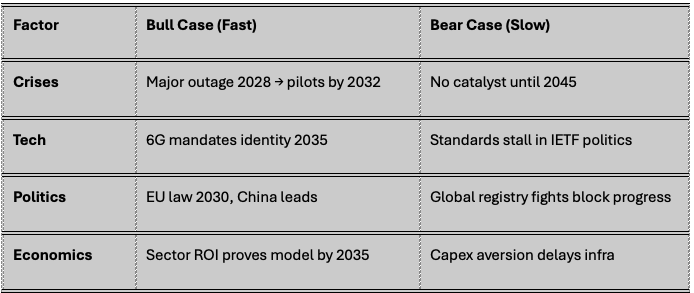
Most likely path: Sector pilots by 2035, national backbones by 2045, true global multi-network reality by 2060. Crises remain the biggest accelerator—without them, add 10–15 years.
Conclusions: A New Foundation for Global Connectivity
The internet transformed human society, enabling unprecedented communication, commerce, and collaboration. Yet its foundational architecture—forged decades ago for a smaller, simpler world—now constrains innovation, amplifies fragility, and fails to deliver the authenticity and resilience demanded by modern realities. Weak identity mechanisms allow cybercrime to flourish unchecked. Concentrated backbone routing creates single points of global failure. Browser monocultures expose billions of devices to systemic risks. Protocol ossification forces one-size-fits-all solutions onto diverse needs.
This document proposes a radical yet feasible path forward: competing global networks designed from first principles, each optimized for specific priorities. Authenticity-first networks bind every packet to verifiable human identities at the link layer, enforced by secure hardware. Fishnet topologies distribute routing across peer meshes, enhancing resilience and frustrating interception. Specialized clients emerge for curated protocol stacks, breaking browser monopolies. Delay-tolerant designs prepare for interplanetary expansion. These are not mere overlays but parallel infrastructures that coexist with the legacy internet during a multi-decade transition.
Precedents abound. Estonia and Belgium deploy national e-ID systems linking cryptographic keys to citizens, powering secure services at population scale. Enterprise zero-trust architectures like Google's BeyondCorp bind identities to devices and flows, proving rapid attribution in production. Hardware secure enclaves from Apple and Android enforce tamper-proof credentials. Sector networks in healthcare and energy already segregate high-stakes traffic with strong authentication. NASA's DTN handles Mars-to-Earth communication, validating divergent architectures for extreme conditions. Clean-slate research from Stanford confirms that rethinking core assumptions yields superior designs.
Practical Steps Toward Reality
Implementation begins small but scales decisively. Lab experiments validate identity-bound traffic tagging and fishnet resilience using tools like Mininet or Kubernetes overlays. Enterprise pilots split "Critical Nets" for operations from "Open Nets" for browsing, measuring blast-radius reduction. Sector sandboxes—MedNet for EHR exchanges, GridNet for SCADA—test governance with regulators and vendors. Minimal clients for finance or healthcare demonstrate leaner, auditable alternatives to bloated browsers. Governance simulations reveal failure modes in multi-network ecosystems.
These proofs-of-concept face no insurmountable technical hurdles. Secure hardware exists. Multi-homing is routine in devices today. Overlay networks deliver fishnet benefits over existing infrastructure. The bottlenecks are social and political: privacy fears demand zero-knowledge safeguards; incumbents resist protocol divergence; global coordination requires crises or competition to catalyze.
Timeline and Catalysts
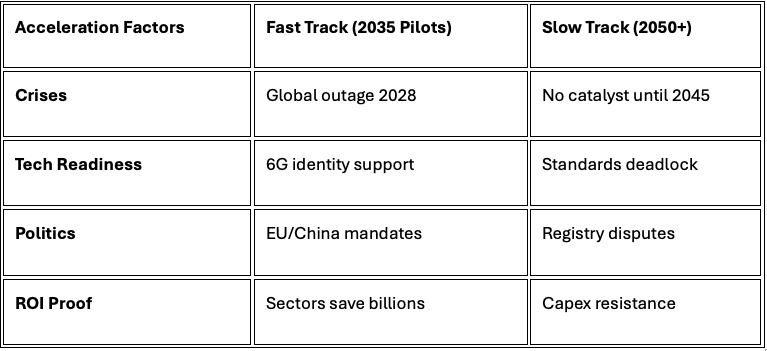
Sector pilots emerge in 5–15 years, driven by regulatory mandates post-ransomware waves or grid attacks. EU NIS2 expansions and US CISA rules accelerate high-assurance networks for finance, health, and energy by 2035. National backbones follow in 15–25 years amid geopolitical races—China's sovereign nets, EU digital identity directives, US export controls on insecure gear. Global multi-network reality stabilizes by 2045–2060, propelled by space economies mandating DTN and climate disasters exposing hierarchical fragility.
Crises remain the accelerant: a SolarWinds-scale backbone compromise or $10 billion hospital outage shifts economics overnight. Absent shocks, inertia adds a decade. Bull cases see 6G embedding optional identity tags by 2035; bear cases stall on IETF gridlock or privacy backlashes.
Acceleration Factors
Transformative Implications
Realized, this vision redefines digital infrastructure. Cybercrime collapses under instant attribution—ransomware negotiators exposed, shadow bidders impossible, troll farms uneconomic. Resilience surges: fishnets weather cable cuts and quakes with graceful degradation. Governance improves: competing networks force protocol evolution without central fiat. Innovation revives: lean clients for MedNet or SpaceNet sidestep web bloat.
Sectors thrive in tailored fabrics. Hospitals exchange records on identity-rich MedNets, slashing misdelivery errors. Banks settle trillions on thin clients immune to browser exploits. Logistics firms route fleets over Critical Ops Nets, containing breaches. Children access hardened networks with parental oversight baked in. Mars colonies trade via DTN, normalizing divergent stacks.
Privacy evolves, not erased. Multiple identifiers per person enable compartmentalization—work, personal, pseudonymous—veiled by cryptography until legal thresholds trigger unmasking. Oversight bodies prevent abuse, mirroring today's banking KYC fused with network primitives.
Risks and Safeguards
Challenges loom. Early authenticity nets risk surveillance if governance falters; decentralized issuance and judicial warrants mitigate. Fishnets demand sophisticated operators; phased overlays bridge the gap. Transition friction burdens users; multi-homing and dev tools smooth adoption, as with desktop/mobile today. Incumbents lobby against splits; antitrust and standards bodies counterbalance.
Yet the status quo exacts higher costs: $10 trillion annual cyber losses, cascading outages, unaccountable disinformation. Patching an ossified core yields diminishing returns. Competing networks inject rivalry into infrastructure itself, mirroring early ISP competition before consolidation.
The Path Ahead
New global networks demand audacity: international consortia for identity registries, IETF/3GPP tracks for Layer 2 tags, vendor roadmaps for fishnet silicon. Philanthropists fund pilots; sectors self-organize; governments mandate for critical paths. Experiments today—lab VLANs, enterprise splits, sector sandboxes—generate irrefutable data.
The internet was humanity's first global network. It will not be the last. By embracing competition at the architectural layer, society builds connectivity worthy of its centrality: secure, resilient, accountable, innovative. The question is not if, but when—and whether crises force acceleration or visionaries seize the lead.