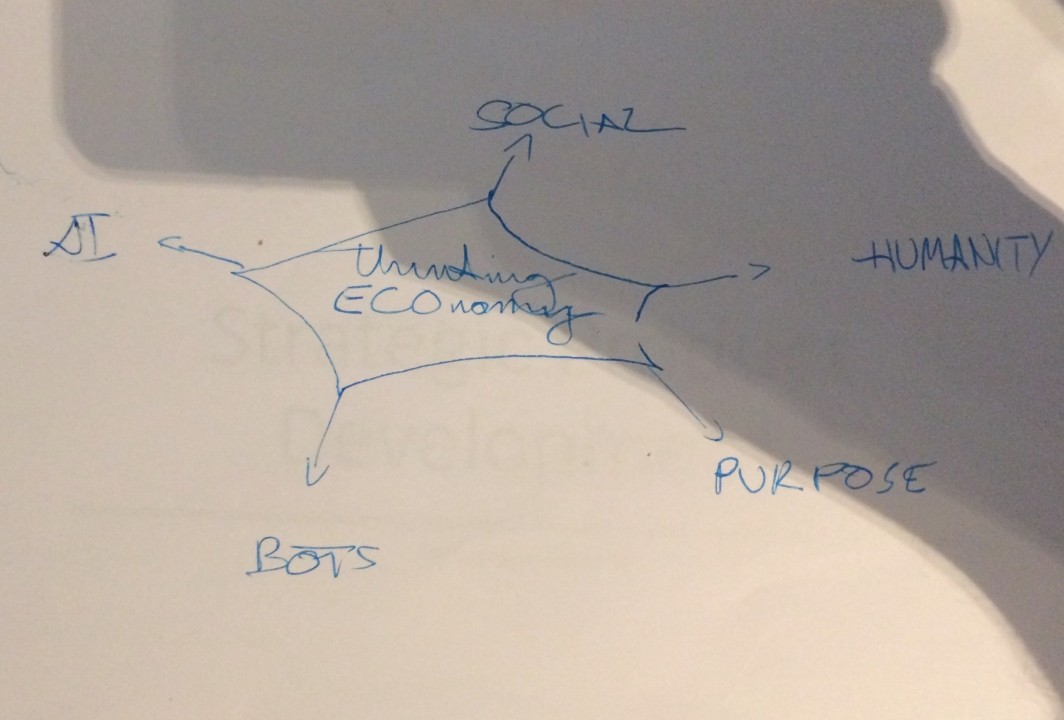
Think of the economy as a tablecloth, only there is no table. Just assume the tablecloth, once unfolded, will be strong enough to also be the table. If two people pull on either side, it has no useful horizontal surface that can represent a table. Not any person let alone seven billion could sit at it or on it (just in case you're having a picknick). Now add a third person to pull on another corner of the tablecloth economy. Now you have a triangular surface which starts to become useful. Look around and recognize all the relevant forces that are significant and mature enough to pull on another end. I have found five forces so far; artificial intelligence, social, humanity, purpose, and bots. With these five I can do something. I can spread the tablecloth in five directions creating a larger surface. Still it's tricky because all these five forces need to exercise almost equal force over a prolonged period, say at least a decade. This requires working together and agreeing on common goals beyond the EBITDA or the current fiscal year. Without this vision, individualist forces might be left to their own devices, herding up everything else with eventually no tablecloth, except some remnants torn apart from what once was a pristine tablecloth.
Tech today is being used to reduce the global economy simply because we lack vision and patience. We will automate to cost-cut and power grab anything whenever we can, just because we can. Don't even mind civil liberties, who knows what those were for? The result today is that that 25% of the US Standards&Poors (S&P) 500 index, representing the US corporate economy is made up of five companies. Each of their valuation is so high and has kept increasing for so long that there is no way these companies can spend all cash they have been accumulating in the process without at least forgoing some common sense. Still investors are all onboard. They are mouthwatering with the promise of continues growth as has been the case for the past three decades if not longer. Apple, Microsoft, Facebook, Amazon, Alphabet (Google) are all sound companies but today's economic ruleset makes them spend cash solely because they have too much of it. A few years back Apple could posture about its 300 billion dollar war chest. Still this cash is laying around doing nothing. That's not what you can keep saying on your annual shareholder meeting year after year. Moreover it is no longer needed to give your shareholders any dividends if the stock price keeps on going up and up and up. Amazon showed us this even before we had a dot-com bubble in 2000 for fossils like me that can remember a pre-internet age. Big tech companies that are not the big five aspire to become part of that ever growing 25%. Pretty soon we will have to start asking if there is anything else besides tech in the global economy. Other huge, non-tech, companies are off course still around. Unlike tech, they employ the majority of the planet. Some of them several millions of employees at a time, enough for a small country. Several years back Wallmart for instance used to provide work to 3 million people. To put things in perspective here are some numbers which I quickly found on the net a few months back in May 2020:
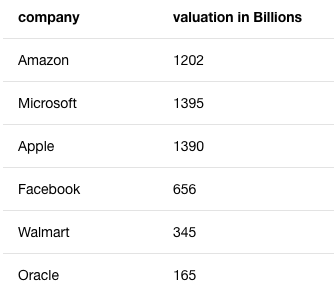
These numbers were pulled together searching the web and are by no means meant to be accurate. In particular Google, now known as Alphabet, is hard to size up with its different sub entities and listings. I for one could not find a consolidate annual report for Alphabet.
The latest in the news this week is that Apple's valuation had another craze. Is is now surpassing the 2.000 billion dollar mark. Apple employs 137.000 employees globally according to Google search. The same Google today told me that Walmart has decreased its staff to 2.200.000 people. You might start to get a feeling about where I'm going with all this. Let me mix up all these numbers a bit further to give some perspective.
The following calculation shows how much value on average an employee of a company can influence. This is purely hypothetical, but the sheer difference is not without meaning.
- Apple: 2.000.000.000.000 / 137.000 = 14.598.540 $
- Walmart: 345.000.000.000 / 2.200.000 = 156.818 $
This means that the average worker at Apple has influence over 93 times more value in the global economy than the average worker at Walmart. This can't be right now can it?
I have to admit, this logic is partly flawed as it implies that anyone working for a company has a direct proportional influence over the value that a company creates in the economy. This is not always the case. Still companies in their very essence are created by people working together or even a single individual to create value in the economy so there is a link (even if it is indirect and other factors differ).
The non-tech economy is being squeezed out of the market because the total value the global economy creates is going increasingly to (big) tech companies. This has a direct impact on everyone. Tech employs only a small percentage of the global work force, yet it is getting an ever bigger chunk each year of the planet's GDP number. All the other companies that are still responsible to give a job, a purpose, and an income to most, proportionately have less each year. Less money those other companies can spend, less to pay their employees, less employees they can pay. This means most employees have less income and spend less when they in turn put their consumer hat on. Eventually also big tech will suffer because there will be less consumers of the products and services they provide or they will get less money for it. If the world keeps this up much longer only employees of big tech will be able to be their customers. How can that work?!?
Simple, I believe it can't. The global economy is broken. It has been for some time.
The rule set that came to be over almost two centuries since the industrial revolution and that today still governs economic reality are broken. Lot's of things went wrong especially since the end of the cold-war but I'll stick to the topic of this article and provide some ideas that can bring hope. It shouldn't all be dystopian despair staring at us.
So what is my message?
- We need to be realistic about what technology can bring, the good and the bad.
- We also need to be humble about trying to intervene when economic forces are at play.
- An interventionist approach calling a halt to automation to save jobs will not work. How would you even implement such a ban on chatbots or other robotics?
- The forces of this technology has been unleashed and can't be put back in pandora's box.
When a company has an opportunity to become more efficient, more productive, it often has found a repetitive task that can be executed quicker, with less human intervention. Sometimes even with none at all. This frees up employees from these often tedious or even dangerous work activities.
The good in all of this is that sooner or later a necessity will arise that forces us to innovate and to invent. But in the meantime? Now that it is clear that there is a problem, what can we do? Can we avoid total crisis whatever its shape or form? This is where I tend to take a deep breath. Those who might notice might ask me if all is well. I'm just sighing some trouble away.
Okay, now stepping back a moment. Innovation together with an open global economy is what allows global GDP to grow. This does in turn require a common rule set, no matter how small as long as everyone can agree on it, preferably without too many trade wars and protectionism. Unfortunately sometimes you need do more then talk and perhaps a trade war between China and US had become inevitable. But is either to blame? What I know is that the World Trade Organization (WTO) wasn't able to keep the trade peace as it meant to and did ever since the world started to recover from World War II. It did great things like the Bretton-Woods accords. Image if today every country would still be obliged to have in it's possession the equivalent of all its cash in gold-bars stored by each central bank. The global economy would have a hard limit of the value of all gold. Money itself would be scarce. Either that or hyperinflation as in the 1920's and 1930's might make it worthless.
I'm not a believer in advocating rules that would somehow force companies to retain employees when they have simply become more efficient, better at what they do. Sometimes letting people go can be a good thing, perhaps a distraction less when focus is needed. However using technology for efficiency gains for the sole purpose of cost cutting is in the long rule catastrophic as it makes the value of the global economy shrink. Instead we need to think more and harder how else new technologies can be used for creating new value and not less. Products, services that add something we didn't have before, that most of us didn't even knew we would ever need. That is how the economy grows and how we will eventually make the planet sustainable for an ever growing number of beautiful human beings. Each person is different, each can bringing something unique. Companies, their boards, shareholders and their workers can become better at figuring out how everyone involved can contribute to innovation.
This article might be a bit boring and lacking cool visuals, charts, canned themes and so. Maybe I have become somewhat lazy myself or maybe I'm about to use one of my proven tricks. If you are still reading this you might start to wonder just that. Us humans should revert to what we are best at; imagination. It might have become hard and we have become unaccustomed by lack of new necessities, new problems, new challenges. What can you create that others cannot? Don't force that answer right away. Let those thoughts simmer for a bit. Go for a walk. I like the green park here two blocks away from my flat. It’s a bit hilly. Nature changes everyday and really I can use the exercise.
Back already? Okay, good. Now imagine a future that you create. Whenever possible first think how you can do something you haven't done before. Only when having done so, go and look it up online or ask a colleague or friend or even read the manual RTFM style. You'll be able to compare your own thoughts and ideas much better against those that were already created by someone else. Chances are more likely that you will come up with something truly new. Even if those chances are always somewhat on the low side, they do exist. And again try not to kill your imagination first with an overdose of knowledge before you try to improve or create something. Try before you learn so you know why learn and if you should still try. Knowledge might just kill all necessity to create or at least that's what we tend to believe sometimes because something alike or similar has been done before! But has it really?
So my magical economic model requires a bit more thinking and patience. Here it goes in numerical order:
- Imagine what is possible. If needed force yourself to. This might be new to you, but you have it in you.
- Create as if you had a clean slate and if you were the first person creating what you just imagined.
- Learn from what others have already created.
- See what you have thought of or created that is different from what already existed.
- When it is there, search for value in that difference. Every now and then you will create new value no one ever has.
This change in mindset is how we can ensure every now and then us unique individuals will think of something that might bring new value to any company that no one else has ever thought of before. Companies can nurture this and provide a more positive answer to the challenges of today's economy and the planet's.