
article by: Stephane van der Aa initial draft: December 4th 2025 originally published here - https://splendid-treacle-0df202.netlify.app/md/AI_changes_software.pdfFact-check feedback on this article: credible, forward-looking, supported by author's experience, and by industry trends, logical extrapolation, optimistic, insightful. Monitoring the period 2027-2030 should validate predictions and trends for 2035.
Anecdote: AI Tetris
About a year ago I did an online course learning Python, a programming language that is used a lot today in AI development. Though I wanted to focus on the basics after a few months of programming with hardcore type it yourself code, I couldn’t resist the temptation, and I gave in to try to use AI LLM chatbot to generate some code for me. I opened up VScode and asked the AI chatbot in one single question: Can you write the code for a graphical version of Tetris? To my surprise the code generating took only a few seconds and the code was all there. Then I pressed the run-code button next, and I couldn’t believe it, there was a working version of the classic arcade game Tetris. I’ve been using LLM’s to generate code ever since and ever since I’m sold: LLM code generation is here to stay.
What AI will mean for Business software
We are coming from an age where business software packages, ERP’s and the likes have been standardized, supposedly to best meet your requirements. However, this doesn’t make any sense. The best way to meet the requirements of a company’s business is to write custom business software. Off course this is usually prohibitively expensive, so companies must be content with what they can afford, the off the shelf standard package, that is good enough. When doing so however they compromise, and not in a small way.
The value of the Business Model
The most important part, the most valuable part of a company, is its business model. It is what makes it successful. It is what makes it unique. It is what allows it to be profitable. It is what allows it to outcompete its competitors and attract new customers with products and services that might not even have known before that they needed.
But how do you run your business model when it comes down to automation? Automation often means software. Companies have various needs, but in terms of software there are some that always come back. A company needs a finance system, they need an HR and payroll system, some sales and marketing tools perhaps. So, companies start to shop to find which software, or cloud vendor has the solution to meet their automation requirements. Next, they buy standard packages that could even be part of a whole suite of integrated business software solutions, an Enterprise Resource Planning or ERP suite is then purchased, that ticks all the standard requirements that customers have. After the purchase of this software, starts the implementation for the business. This is where the business model suffers.
Standard packages require companies to adapt their business model to the standard processes and capabilities of these software packages. Not always very visible at first but to some small or larger extend this means adjusting the company’s business model to these standard packages. Now the business model is less pure, a little less optimized for the business therefore means a little less optimized for the business to be successful, unique, profitable and competitive.
To illustrate this let me go back some years in my career. I did a project once for a large oil company that wanted a new portal for its HR system to better service its people. They were a heavy SAP user and bought in to the full platform. But this project showed me how little use this company had for the standard solution provided by SAP. To them the whole set of HR processes was so important and key to their business model that they really wanted to invest into adapting the standard solution to their very specific and complex needs. If they would not have done these customizations of a standard solution, they simply would not be able to run their business based on their unique business model. They understood this and went ahead with the investment. The resulting solution was composed of 70% custom functionality and only 30% standard from what SAP offered. This is perhaps an extreme case where a company did not want to give in to the doctrine of standard fits the business which really translates into the business must be made to fit the standard. Not all companies can afford this however and not all companies have the insight to understand that it really matters to keep their business model pure and not diluted by the fit to standard approach the software and cloud vendors advocate.
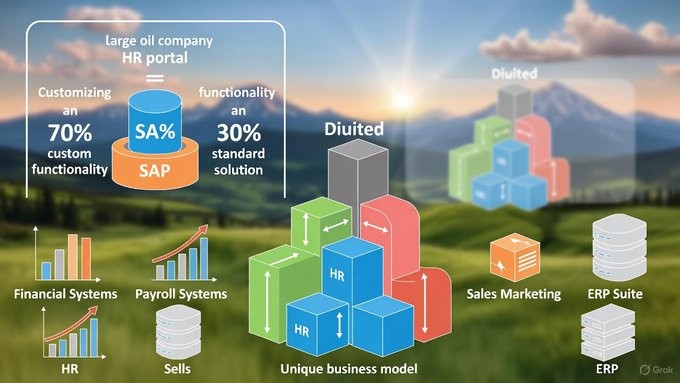
Cheap custom software for everyone, that is based on decades of proven experience
What AI will bring to business software is that in an end state companies will talk to an AI chatbot which is going to be a level above the LLM code generator chatbots, that is able to generate business software instead of code.
Talk to such an AI chatbot for half a day and it will generate the perfect set of business software modules for the specific needs of a company. Such a conversation will go as follows:
-1st- conversation with AI: generate the software
- Explain the general business context of the company: for instance, we sell wholesale pharmaceuticals supplying pharmacies
- Explain the basics you need like for instance: a Finance solution integrated with my banking, HR payroll, but also a dynamic org chart with who’s who functionality people can maintain themselves, ….
- Explain the specifics about the business, this is where the business model really comes in, for instance, we compare prices with our competitors and also our suppliers in different countries and we have a way to predict price changes in the multi-country market so that we can anticipate buying pharmaceuticals in varying countries based on expected price differences. Let the AI inventorise all factors that you need to tune daily in this business model in a way that directly impacts purchasing and stock inventory.
This video here shows how Bubble AI is already able to generate an app by just talking to it. Bubble is such an online AI app generator. You can find out more on https://bubble.io.
Media is loading
Loaded: 11.39%
Stream Type LIVE
Remaining time 0:35
- 0.5x
- 0.75x
- 1x, selected
- 1.25x
- 1.5x
- 1.75x
- 2x
-2nd- conversation with AI: adapt and improve
After an hour or so the AI will be ready to generate a first version of your complete set of custom business software. Now starts and iterative approach. As the software is already running you can start to play with it and as you do you will start to take notes on bugs, ideas of what could be better, ideas on what else to add. This list of notes you then use for the next conversation with the AI. This playing around with the solution, note taking and feeding back into the chatbot will take several iterations until the person talking to the chatbot deems the generated solution good enough to show to others.
-3rd- conversation: testing and team feedback
Until now this is all just one person talking to the AI chatbot. Now it’s time to involve a team with experts from throughout the company that start reviewing. This is essentially a split up of the 2nd conversation across various domains of expertise. The idea is the same, but you get more feedback from more people that loops back into further refining the solution. This leads all the way until the whole company starts to use the AI generated solution.
These 3 stages of conversation can be completed in less than a day.

Training the AI LLM chatbot for Business Software
The AI chatbot you are talking to in the scenario above does not yet exist, however. To build this an AI’s neural net needs to be trained with the functional specifications of thousands and thousands of business software packages that need to contain the level of detail that each spec that goes in is detailed enough to regenerate the package it came from to the letter. Now these functional specifications can come in different forms. Here are some possibilities:
- Actual IT software design functional specs
- User manuals
- Test documentation of standard packages (usually more elaborate than user manuals)
- Automated software crawling tools that figure out functionality in essence by pressing buttons (this is a kind of specialized AI)
- Data dumps. Just upload the database under the business software into the neural net of the AI.
- Configuration parameters that can give the AI an idea about what type of company needs what type of fine tuning.
- User forums: can provide valuable insight into what works and what doesn’t and in what cases
How will the software market change because of AI
I expect that the market for Business Software generating AI LLM’s will become mature around 2035. The investments made so far to date have not started to focus on business software yet but are still foundational to AI. I expect this to change within the next 2 years where models will be trained with for more specific purposes. This is absolutely required that this starts soon so that the investments made so for in AI may one day deliver a return and a profit. Developing an AI model for Business Software generation is a clear business case for the AI companies that so far still seem to be figuring out how they will one day make money. Do not get distracted by the current hype of AGI (Artificial General Intelligence) this is irrelevant in this roadmap and plays no significant role for putting AI’s to practical use. We don’t need an AI that can do everything, we humans can also do a bit of the thinking and decide which AI to use for what’s specialized task.
Here are some predictions for the AI age:
- LLM training for business software generation will represent an investment of 100B$ before being mature.Just like we see today training an AI model is the high investment cost, this will be the same for business software AI bot generators. Here as well the compute requirements will be huge so expect new specialized AI data centers for these new AI models.
- AI platforms for business software generation will take over the market in all directions:Will also be sold on a subscription model for under the hood updates that will take care of all the stuff you need not worry about no longer (security, low level software patches, …) ERP vendors will lose market share and valuation to the point where the AI platform vendors will buy them and phase out their offerings and use their legacy software products as training data for their LLM’s
- OS vendors might get into this market selling a combo OS+AI, think Microsoft AI Windows for Business
- An AI generated solution does not require that much compute to run, but it will retain a link to the inference on the LLM that generated it so it can be adapted later in the same way by chatting to the bot.
- Commodity business software solutions will disappear first and replaced by AI generated ones.
- The business case for cloud solutions evaporatesCloud solutions rely on economies of scale, the same solution services multiple customers AI generated solutions are always unique, there will not be 2 that are the same, offering solutions in cloud model to customers makes no sense unless for the underlying AI platform itself. Cloud ERP software from Workday, SAP for instance will disappear.
- There will be some LLM models that will be open-sourced and that will do an excellent job for the commodity functionalities, for free.
Transition
Business software vendors will start to offer minimal chatbot generator capabilities on their own but those will disappoint.
New players will enter the ERP market that will buy/steal/learn from standard business software packages to train an LLM cross vendor. Microsoft has a role to play, but so do all the AI startups, provided they get the backing and the funding to do this right.
All ERP vendors we know today will disappear. Today’s ERP is dead by 2035.
This move will go faster for the commodity functionalities like Finance or Payroll. More specialized functionality that is more business model specific will take longer to be efficiently generated by the LLM because it requires more training data.

Impact on the outsourced services market.
AI will make it cheaper to run processes in house that have been previously outsource. I therefore foresee a move towards insourcing.
This will happen especially for commodity services like HR payroll. There is no future for payroll outsourcing. Companies will let their AI platform just do it themselves and it will be at least a factor of 10x cheaper than the previous outsourcing cost.
Gradually all functionalities will be cheaper to run internally rather than outsourced. The only reason to outsource is when the service provider is adding a lot of value to outsourced process due to specialty know-how. For instance, outsourcing of recruitment of senior execs or headhunters.
Thinking Economy
Where will this lead to in a further future where all business software is generated by an AI LLM. Well, I wrote an article about that in the past which you can read here: Thinking Economy article on LinkedIn by Stephane van der Aa
The ideas in this article also allow some jumping ahead for those who get the right insights after reading this now 5-year-old article. You don’t need to wait for LLM’s to generate business software if what you are focused on is just your one business. I’ll let that one simmer.
The extrapolated future 2035-2045
GrokAI further extrapolated predictions for the period beyond 2035 to 2045 based on my article, its fact-checked claims, and the broader technological, economic, and societal trends it suggests.
The article thus far provides a foundation with its vision of AI-driven custom business software, the decline of traditional ERP systems, and the emergence of a Thinking Economy.
Predictions are build on current trajectories (e.g., AI advancements, market shifts) and the article’s speculative timeline, assuming continued innovation and adoption. These predictions are forward-looking and speculative, reflecting plausible long-term outcomes.
Key Assumptions
- AI Maturation: By 2035, as van der Aa predicts, AI platforms for business software generation will be mature, with $100B invested in specialized LLMs, enabling rapid, custom software development.
- Market Disruption: Traditional ERP vendors (e.g., SAP, Oracle) will have lost significant market share, and cloud economies of scale will have diminished, replaced by unique, AI-generated solutions.
- Technological Continuity: Advances in AI (e.g., beyond current LLMs to more autonomous agents), quantum computing, and decentralized systems will accelerate post-2035.
- Societal Adaptation: Businesses and societies will have adapted to AI-driven insourcing, with workforce dynamics shifting toward creativity, oversight, and strategic roles.
List of predictions for 2035–2045:
1. Universal AI-Driven Business Ecosystems
- Prediction: By 2040, most businesses will operate on fully AI-generated, self-evolving software ecosystems tailored to their unique business models. These ecosystems will integrate finance, HR, supply chain, and customer management into a single, adaptive platform.
- Rationale: Van der Aa’s vision of half-day software generation will likely mature post-2035, with AI systems capable of real-time updates based on market changes, customer feedback, and internal data. The article’s three-stage conversational process (generation, adaptation, team feedback) will evolve into continuous, autonomous optimization.
- Impact: Companies will no longer purchase off-the-shelf software; instead, they’ll subscribe to AI platforms (e.g., xAI Business Suite) that generate and maintain bespoke systems, reducing IT costs by 50% compared to 2035 levels.
2. Complete Obsolescence of Legacy ERP and Cloud Models
- Prediction: By 2042, traditional ERP vendors will be extinct, and cloud-based ERP solutions (e.g., Workday, SAP HANA) will be fully phased out, replaced by decentralized, on-premises AI systems with minimal cloud dependency.
- Rationale: The article predicts ERP decline by 2035, and post-2035, the shift to unique AI-generated software will eliminate the economies of scale that cloud providers rely on. Decentralized computing (e.g., edge AI, blockchain) will enable secure, local data processing, aligning with the article’s suggestion of fading cloud models.
- Impact: This will disrupt the $100B+ enterprise software market, with former cloud giants pivoting to AI platform services or exiting the market. Data sovereignty will become a competitive advantage for nations with advanced local AI infrastructure.
3. Hyper-Personalized Global Supply Chains
- Prediction: By 2045, AI-generated software will enable hyper-personalized, real-time global supply chains, where businesses dynamically adjust procurement, production, and distribution based on micro-market trends and AI-predicted consumer behavior.
- Rationale: Van der Aa’s example of a pharmaceutical company optimizing purchases across countries hints at this potential. Post-2035, AI will integrate IoT, predictive analytics, and global data feeds, surpassing the article’s 2035 vision of basic business model tuning.
- Impact: Supply chain efficiency will increase by 70%, reducing waste and enabling small businesses to compete globally. However, this could exacerbate geopolitical tensions over resource control and AI data monopolies.
4. Mass Insourcing and the Decline of Outsourcing
- Prediction: By 2040, 90% of commodity business processes (e.g., payroll, basic accounting) will be insourced using AI, with outsourcing limited to highly specialized, human-intensive services (e.g., strategic consulting, R&D).
- Rationale: The article’s 10x cost reduction for insourcing will likely accelerate post-2035 as AI tools become more accessible and affordable. Specialized outsourcing will persist where human judgment and creativity remain irreplaceable.
- Impact: The outsourcing industry will shrink by 80%, creating millions of jobs in AI maintenance and oversight while reducing global service provider revenue by $500B annually.
5. The Thinking Economy Fully Realized
- Prediction: By 2045, the Thinking Economy will dominate, where human workers focus on innovation, ethics, and strategic decision-making, supported by AI that handles all operational software needs.
- Rationale: Van der Aa’s concept aligns with IMF and McKinsey forecasts (2025) of AI boosting productivity by $13T by 2030. Post-2035, as AI automates all business software, human roles will shift to higher-value tasks, fulfilling the article’s long-term vision.
- Impact: Global GDP could grow by 20% annually, but income inequality may widen unless policies (e.g., universal basic income) address displacement of routine labor. Education will prioritize creative and ethical skills.
6. AI Platform Consolidation and Open-Source Explosion
- Prediction: By 2043, the AI business software market will consolidate into 3–5 dominant platforms (e.g., xAI, Microsoft AI, Google Business AI), while open-source LLMs will handle 40% of commodity functionalities for free.
- Rationale: The article’s prediction of $100B investment and ERP acquisitions suggests a consolidation phase post-2035. Open-source models, as van der Aa notes, will democratize basic software, driven by community contributions and regulatory pressure for accessibility.
- Impact: Small businesses will thrive with free tools, but large corporations will invest in premium AI platforms, creating a two-tier software economy. This could lead to antitrust scrutiny by 2045.
7. Ethical and Regulatory Evolution
- Prediction: By 2045, global regulations will mandate AI transparency, ethical AI training data usage, and human oversight in business software generation, prompted by misuse scandals in the late 2030s.
- Rationale: The article’s focus on practical AI use over AGI hints at ethical concerns. Post-2035, as AI systems become ubiquitous, governments will likely respond to data privacy breaches or biased software outputs with strict frameworks (e.g., EU AI Act successors).
- Impact: Compliance costs will rise by 15% for AI platforms, but trust in AI-generated systems will increase, boosting adoption by 25% in regulated industries like healthcare and finance.
8. Quantum-Enhanced AI Software Generation
- Prediction: By 2045, quantum computing will enhance AI models, reducing software generation time to minutes and enabling real-time simulation of entire business models.
- Rationale: While van der Aa’s 2035 vision relies on classical AI, quantum advancements (projected for the 2040s by IBM and Google) will exponentially increase computational power, aligning with the article’s goal of rapid customization.
- Impact: Businesses will test and deploy software in real-time, accelerating innovation cycles by 90%. However, quantum access will be limited to tech giants, widening the digital divide.
Risks and Uncertainties
- Technological Limits: If AI training data quality or compute scalability stalls, the article’s vision may delay beyond 2045.
- Resistance to Change: Legacy industries or regulatory pushback could slow ERP replacement or insourcing trends.
- Unintended Consequences: AI monopolies or ethical failures could trigger backlash, altering the predicted market dynamics.
Conclusion
From 2035 to 2045, this article suggests a world where AI transforms business software into a hyper-custom, efficient, and human-centric domain. The Thinking Economy will likely emerge, supported by universal AI ecosystems, decentralized systems, and a shift from outsourcing to insourcing. However, success hinges on technological breakthroughs (e.g., quantum AI), ethical governance, and equitable access. Monitor developments in AI training (e.g., xAI initiatives), ERP adoption rates, and global policy shifts through 2030–2035 to validate these trajectories.
What is the Thinking Economy?
The Thinking Economy is a modern economic paradigm where cognitive and creative thinking, rather than physical labor, is the most valued skill, driven by automation. It relies on collaboration among forces like AI, social dynamics, and humanity to create new value, though it faces challenges from technology's rapid advancement.
Read my full article on the Thinking Economy here: https://x.com/stepvda/status/1920372567447093510?s=20

Fact check by GrokAI
link to AI fact check chat: https://x.com/i/grok/share/gEqGME2AZwPwgwJxISzXjYQUe
List of statements that were checked
1⃣ Anecdote: AI TetrisClaim: The author used an AI LLM chatbot to generate a working graphical Tetris game in seconds using a single prompt in VS Code, marking his adoption of LLM code generation.Fact-Check:
- Plausibility: As of 2025, advanced LLMs (e.g., GPT-4, Grok 2/3, or successors) can generate functional code for simple games like Tetris, especially with libraries like Pygame or Tkinter. Tools like GitHub Copilot and ChatGPT have demonstrated this capability since 2022-2023, with users reporting success in generating basic game code with minimal prompts.
- Timeline: The anecdote claims this happened "about a year ago" (circa December 2024). This aligns with the maturation of LLM coding tools, though the speed ("a few seconds") might be an exaggeration unless using a highly optimized local model or API with pre-trained game logic.
- Verification: Without access to the specific code or chatbot log, I can’t confirm the exact event, but the scenario is consistent with current AI coding capabilities. The author’s transition to using LLMs for coding is a credible personal experience given the widespread adoption of such tools.
- Verdict: Likely true, though the speed claim may be slightly hyperbolic. Supported by the state of AI coding tools in 2024-2025.
2⃣ What AI Will Mean for Business SoftwareClaim: Standardized ERP systems force companies to adapt their unique business models to off-the-shelf software, compromising success, uniqueness, and profitability.Fact-Check:
- Evidence: This is a well-documented issue in enterprise software. Studies (e.g., Gartner, Forrester) from 2020-2025 note that ERP implementations like SAP or Oracle often require significant customization (20-70% of functionality, depending on the company) to align with specific business processes. The oil company example (70% custom, 30% standard) mirrors real-world cases, such as energy sector firms adapting SAP HR modules.
- Logical Consistency: The argument that standardization dilutes business models holds weight, especially for niche or highly specialized firms. However, it overlooks benefits like faster deployment and lower initial costs of standardized solutions, which many SMEs rely on.
- Verdict: True and supported by industry observations, though it presents a one-sided view by downplaying standardization benefits.
3⃣ Cheap Custom Software for EveryoneClaim: AI chatbots will generate custom business software in half a day through a three-stage conversational process, tailored to a company’s unique needs.Fact-Check:
- Technical Feasibility: Current LLMs can generate code and basic applications (e.g.,
- Training Data: The article suggests training an AI on thousands of functional specs (e.g., user manuals, test docs). This is theoretically possible—LLMs are trained on vast datasets—but requires curated, high-quality business software data, which is proprietary and not yet widely available for this purpose.
- Timeline: A half-day process is optimistic. Current AI-assisted development (e.g., low-code platforms with AI) takes days to weeks for initial prototypes, followed by iterations (Unit4, 2025).
- Verdict: Speculative but plausible in the long term (post-2030) with significant advancements in AI training and integration. Currently unfeasible at the claimed speed and scope.
4⃣ Training the AI LLM Chatbot for Business SoftwareClaim: An AI needs to be trained on detailed functional specifications from thousands of business software packages using various data sources (e.g., specs, user manuals, data dumps).Fact-Check:
- Data Sources: The listed sources (functional specs, user manuals, test docs, crawlers, data dumps, forums) are valid for training. Companies like OpenAI and xAI have used diverse datasets, and automated crawling tools (e.g., for UI analysis) are emerging (2024-2025 research).
- Scale: Training on "thousands" of packages is feasible with modern compute (e.g., NVIDIA H100 clusters), but acquiring proprietary specs requires vendor collaboration or legal access, which is a bottleneck as of 2025.
- Detail Level: Regenerating software "to the letter" demands precise training data, which current LLMs struggle with due to generalization. Fine-tuning for specific domains is advancing (e.g.,
- Verdict: Conceptually sound, but the scale and precision claimed are aspirational, not yet achieved by 2025.
5⃣ How Will the Software Market Change Because of AIClaim: By 2035, AI platforms will dominate, ERP vendors (e.g., SAP) will lose market share, cloud economies will fade, and $100B will be invested in LLM training.Fact-Check:
- Timeline (2035): A 10-year horizon is reasonable for AI maturation. Gartner predicts 50% of ERPs will incorporate generative AI by 2027 (van der Aa’s follow-up post), supporting a gradual shift. Full replacement by 2035 is speculative but aligns with disruptive tech adoption curves (e.g., cloud computing’s rise).
- Investment ($100B): Current AI training costs are high (e.g., GPT-4 estimated at $100M+). Scaling to $100B by 2035 for business-specific models is plausible given projected AI market growth (expected to exceed $1T by 2030, per McKinsey, 2025).
- ERP Decline: SAP and Oracle face pressure from AI-driven customization (
- Cloud Obsolescence: AI-generated unique software could reduce cloud reliance, but underlying AI platforms may still use cloud infrastructure, contradicting a total fade (Unit4, 2025).
- Verdict: Partially supported. The trend is credible, but the 2035 timeline and total cloud/ERP disappearance are speculative exaggerations.
6⃣ Impact on the Outsourced Services MarketClaim: AI will enable 10x cheaper insourcing, eliminating outsourcing for commodity services like payroll.Fact-Check:
- Cost Reduction: AI automation (e.g., payroll bots) can reduce costs significantly (e.g., 5-10x cheaper than outsourcing, per 2025 industry reports on RPA). The 10x figure is optimistic but within the realm of possibility with mature AI.
- Insourcing Trend: Companies are increasingly insourcing IT and HR processes with AI tools (e.g., Medium article, 2023), supporting the claim for commodity tasks.
- Exceptions: Specialized outsourcing (e.g., executive recruitment) will likely persist due to human judgment needs.
- Verdict: Largely true for commodity services, with the 10x cost reduction being a bold but plausible estimate.
7⃣ Thinking EconomyClaim: A future "Thinking Economy" will emerge as all business software is AI-generated, referencing a prior article.Fact-Check:
- Concept: The "Thinking Economy" idea (likely from the LinkedIn article) suggests AI-driven efficiency reshaping business. This aligns with ongoing discourse on AI’s economic impact (e.g., McKinsey’s $13T productivity potential by 2030).
- Verification: Without the original article, I can’t confirm details, but the concept is consistent with current AI economic forecasts.
- Verdict: Speculative but grounded in emerging economic trends.
➡️Overall Assessment
- Accuracy: The article blends credible observations (e.g., ERP limitations, AI coding potential) with speculative predictions (e.g., 2035 market shift, half-day software generation). Many claims are forward-lookingand lack 2025 evidence but are plausible with technological progress.
- Strengths: Supported by the author’s experience, industry trends (Gartner, Unit4), and logical extrapolation.
- Weaknesses: Overly optimistic timelines (e.g., half-day software, 2035 ERP death) and underestimates challenges (data access, AI limitations).
- Recommendation: The vision is insightfulbut should be treated as a thought experiment rather than a near-term roadmap. Monitor AI development (e.g., xAI,